


It’s the beginning of a new school term.
New teacher. New timetable. New clubs. And, inevitably, a new school WhatsApp group.
At their best, the school WhatsApp groups are incredibly useful.
Someone reminds you that it’s non-uniform day tomorrow.
Another parent knows what time the coach is due back.
Missing jumpers are reunited with their owners.
Lift shares are arranged.
Friendships form.
Parents support one another through difficult times.
At their worst, though, they can become something else entirely.
Passive aggression.
Gossip.
Sub-groups.
Competitive parenting.
Complaints about teachers.
People being conspicuously ignored.
Other people being discussed when they aren’t there to defend themselves.
And occasionally, behaviour that looks remarkably like the sort of exclusion and bullying we spend a lot of time telling our children not to engage in.
I say this as an older mum who has been around the block a few times.
Professionally, I’ve spent over 20 years coaching leaders and working with teams and organisations. My practice is psychologically informed and draws on a range of psychological and systemic approaches. I’m an APECS Accredited Master Executive Coach and much of my work involves helping leaders create healthier, more psychologically safe cultures.
So I’m invited into organisational politics and workplace dynamics all the time. And I have seen some fairly dysfunctional workplace dynamics in my time.
Still, nothing quite prepared me for playground politics. Perhaps I shouldn’t have been surprised.
Put a group of human beings together and a system forms. There will be personalities, alliances, hierarchies, unwritten rules and differing ideas about what is acceptable.
Now add our children… and that changes everything.
Because we aren’t dispassionate observers where our children are concerned. We love them fiercely. We want to protect them.
And when we think they have been hurt, excluded, criticised or treated unfairly, mama bear can come roaring out.
That is where things can get interesting.
First, understand your inner mama bear
There is a reason we can respond so strongly when something involves our children.
When we perceive a threat to someone we love, our protective response can become powerful and immediate.
And when we are stressed or emotionally activated, our thinking can change too.
Research on acute stress suggests it can impair some of the executive functions we rely on for reflective decision-making, including working memory and cognitive flexibility. It can shift us towards more reactive and automatic processing.
That doesn’t mean your prefrontal cortex has completely abandoned you while you furiously type into WhatsApp.
It does mean this probably isn’t the ideal moment to press send. As you’re likely in an emotional hijack.
Someone has left your child out.
A comment feels unfair.
Your child comes home upset about something another child has said.
Suddenly, this isn’t a mildly irritating message on your phone. It feels like a threat to the person you would walk over hot coals to protect.
Recognising that response doesn’t mean dismissing what has happened.
Your child may genuinely have been treated badly.
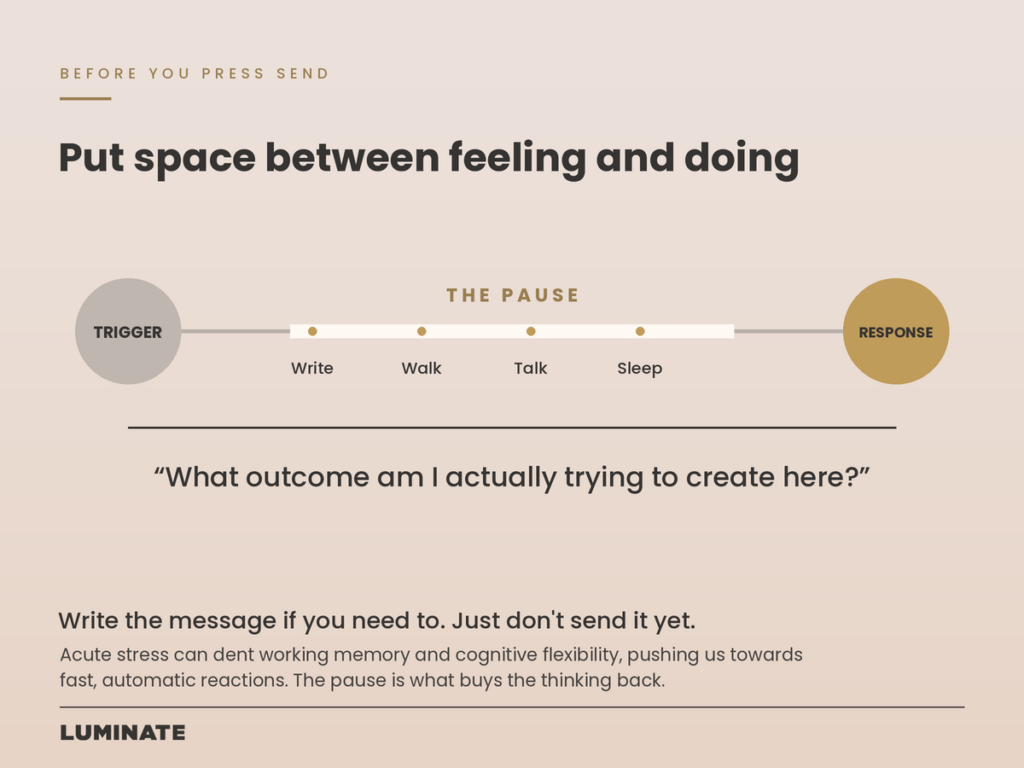
It simply means creating enough space between feeling something and doing something to decide what response will actually help.
Write the message if you need to.
Just don’t send it yet.
Walk away. Perhaps talk it through with someone who you can rely on to be calm and not fuel the drama. Sleep on it.
Then ask yourself: What outcome am I actually trying to create here?
That question alone can save an enormous amount of school-gate fallout.
Remember, nobody is really policing the room
One reason workplace teams have structures is because groups need them.
There are roles, responsibilities, policies, leaders and codes of conduct. Agreed ways of handling conflict.
Your Year 2 WhatsApp group probably has none of these.
It may have an administrator, but being the person who originally clicked “create group” doesn’t necessarily make someone an experienced facilitator of interpersonal conflict.
Often, there are no agreed rules of engagement. No HR department.
Nobody saying, “I think we might need to take this conversation offline.”
That means group norms can develop quickly.
If gossip is tolerated, gossip grows.
If people routinely criticise teachers in the group, that becomes normal.
If passive-aggressive comments go unchallenged, they can become part of the culture.
Equally, calm, kind, helpful behaviour can become contagious too.
We may not be able to control the culture of the group, but we do contribute to it.
Find your rightful and respectful place
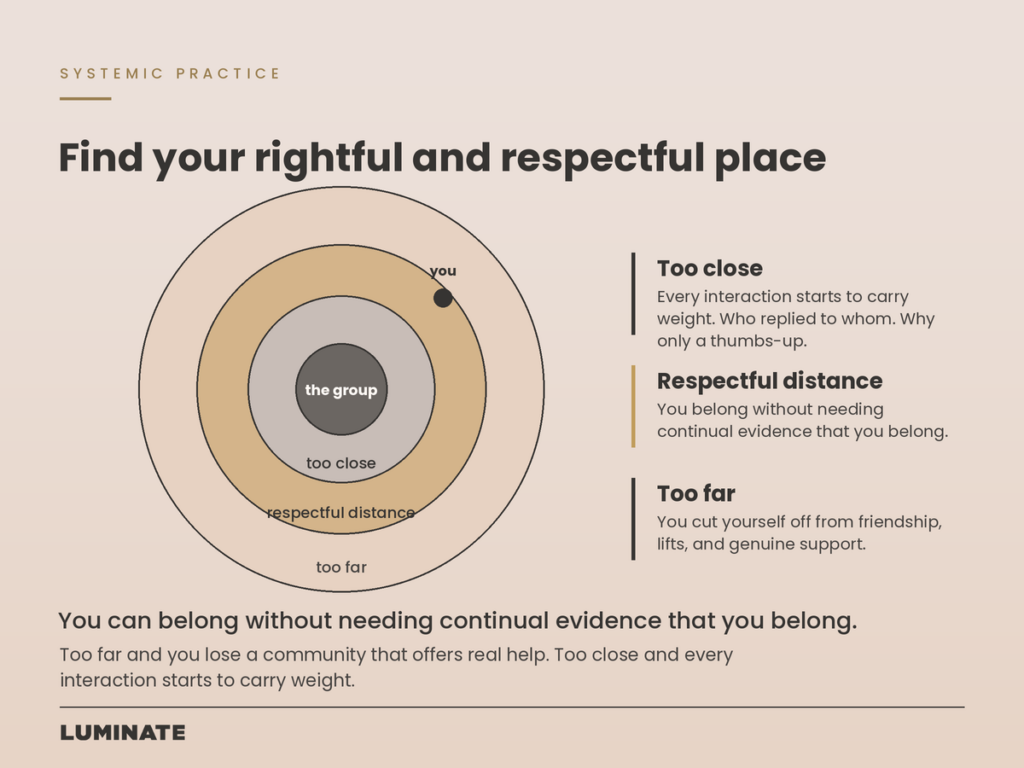
One idea I use in my systemic work is finding your rightful and respectful place within a system.
I find it an incredibly helpful lens for school-parent relationships.
You belong in the parent community, but you don’t have to be at the centre of it.
You can be friendly without needing to become friends with everyone.
You can contribute without being involved in every conversation.
You can care without becoming entangled.
You can belong without needing continual evidence that you belong.
I think there is something powerful about respectful distance.
Too far away and we can disconnect ourselves from a community that can offer friendship, practical help and genuine support.
Too close and every interaction can start to carry too much weight.
Who replied to whom?
Why hasn’t anyone acknowledged my message?
Why wasn’t my child invited?
Why did she put a heart on her message but only a thumbs-up on mine?
Before long, we can find ourselves trying to interpret the WhatsApp equivalent of tea leaves.
Sometimes there is something going on. But often there isn’t.
Either way, preserving a little emotional distance helps us respond more wisely.
Notice when you’re being invited into the Drama Triangle
Another model I find useful is Stephen Karpman’s Drama Triangle, which comes from transactional analysis.
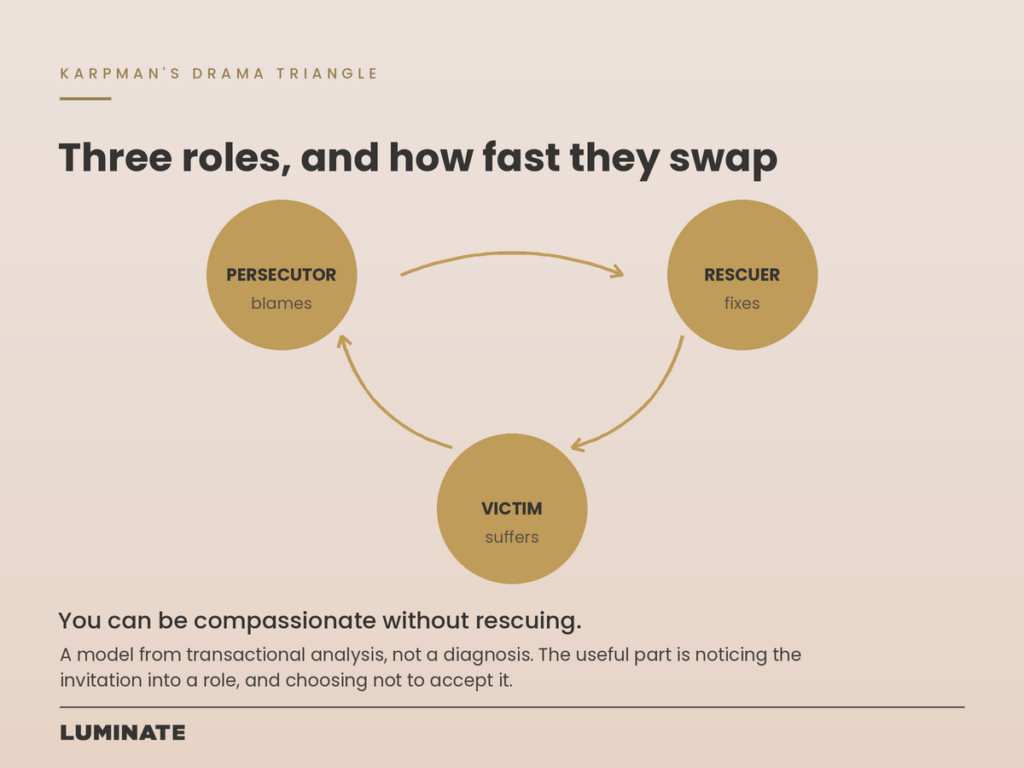
It isn’t a clinical diagnosis. It is a model for noticing an unhelpful pattern that can develop between people.
Karpman described three positions: Victim, Rescuer and Persecutor. The fascinating part is how quickly people can move between them and how often we’re unconsciously invited into the drama triangle.
School WhatsApp groups can offer invitations into this triangle all the time.
Someone posts that their child has been treated terribly. Immediately someone rushes in to rescue.
Someone else identifies the person who is to blame. Other parents join in.
Sides form. Evidence is gathered. Private messages begin.
The original issue may have involved two children falling out over a football at lunchtime.
By 9pm, twelve adults have become involved, and the roles can switch remarkably quickly.
The rescuer becomes the persecutor.
The person accused becomes the victim.
The original victim starts attacking someone else.
Drama creates more drama.
One of the most useful things you can learn to do is recognise the invitation without accepting it.
You can be compassionate without rescuing.
You can acknowledge that someone is upset without deciding who is right.
You can support your child without turning another child into the villain.
You can say:
“That sounds difficult. Have you spoken directly to the teacher about it?”
Sometimes that’s the most helpful contribution you can make.
Don’t triangulate
This is closely connected.
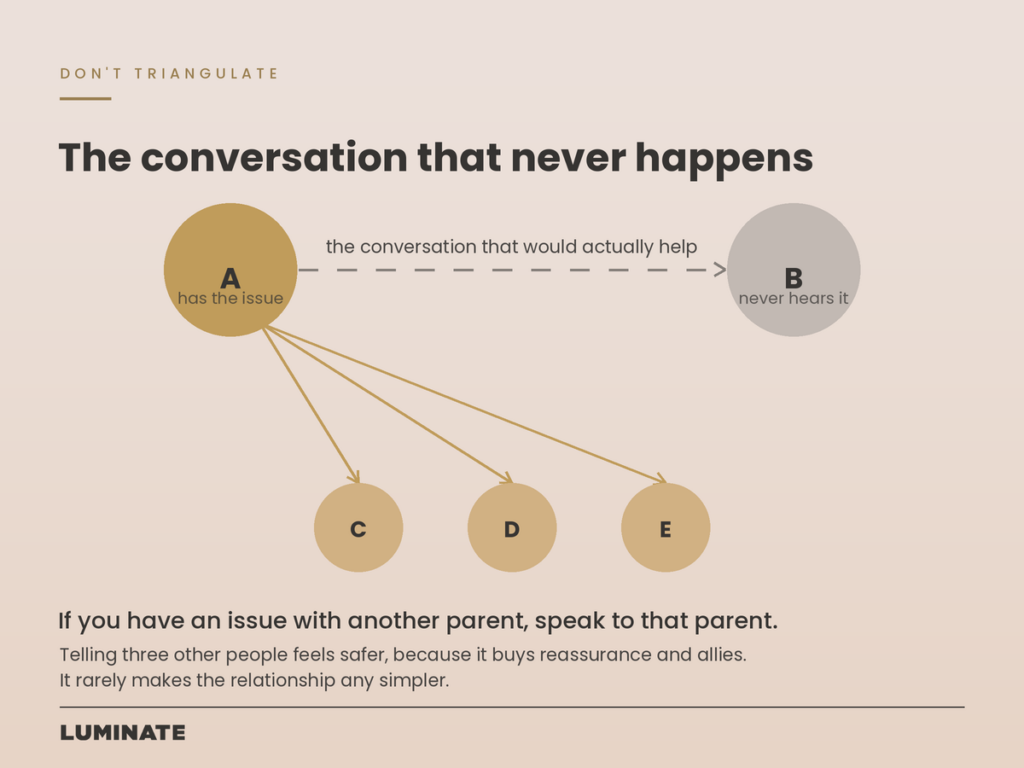
When there is a problem between two people, there is an enormous temptation to involve a third.
If Parent A is angry with Parent B, rather than talking to Parent B, they tell Parents C, D and E.
By the end of the day, everyone knows about the issue except, sometimes, Parent B.
We do this because it feels safer.
We look for reassurance that we are right. We look for allies. We want somebody to validate our experience.
But triangulation rarely makes relationships simpler.
If you have an issue with another parent, where possible, speak to that parent.
If you have an issue with the teacher, speak to the teacher or use the school’s appropriate channels.
If you need emotional support, talk privately to somebody you trust.
Thirty people on WhatsApp rarely need to be involved.
When they go low, go high
Michelle Obama gave us a useful parenting principle when she famously said:
“When they go low, we go high.”
In her 2016 Democratic National Convention speech, she was talking about how she and Barack Obama taught their daughters to respond when people were cruel or behaved like bullies. She immediately connected this with the fact that children watch what adults say and do.
I love that.
Going high doesn’t mean tolerating bad behaviour.
It doesn’t mean being passive.
It doesn’t mean abandoning your boundaries or pretending that something hasn’t hurt you.
It means refusing to let somebody else’s behaviour dictate yours.
If somebody becomes passive-aggressive, you don’t have to become passive-aggressive back.
If somebody gossips about you, you don’t need to launch your own counter-campaign.
If somebody sends an inflammatory message, you don’t need to match their emotional temperature.
You can be clear without being cruel.
You can have boundaries without punishing people.
You can challenge behaviour without attacking character.
That is emotional regulation. It’s also leadership… personal leadership.
And perhaps most importantly, it is what we are asking our children to learn to do too.
Don’t make your child’s friendships carry your friendships
This is one I think parents sometimes learn the hard way.
Your child’s friendship world and your friendship world are not the same thing.
Your child can adore a child whose mother you have absolutely nothing in common with.
You can become great friends with another parent whose child barely notices yours exists. And that’s fine.
We get into difficulty when we unconsciously merge the two.
Adult friendship groups start shaping children’s invitations.
Adult disagreements seep into children’s relationships.
Children become messengers.
A falling-out between two eight-year-olds becomes a falling-out between two families.
Children’s friendships are often fluid. They can fall out at lunchtime and be inseparable again by home time.
Adults sometimes take longer to recover because we’ve added meaning, history and WhatsApp screenshots.
Where you can, give your child space to have their relationships while you manage yours.

Be particularly careful with gossip disguised as concern
There is a phrase worth noticing: “I’m only saying this because I’m concerned…”
Sometimes someone genuinely is concerned.
Sometimes gossip has simply put on a respectable coat.
Before you write something about another parent, teacher or child, imagine that person standing next to you.
Would you still say it?
Would you phrase it differently?
Would you share the information at all?
And if this is a genuine concern about safeguarding or welfare, does it belong in a school WhatsApp group in the first place?
Usually, the answer is no.
Mute is a boundary, not a moral failing
Possibly my most practical piece of advice.
Mute the group.
You do not have to give 30 other parents continual access to your nervous system.
You don’t need a notification every time somebody remembers another question about World Book Day.
You don’t need to watch a disagreement unfolding live.
And you certainly don’t need to discover at 10.47pm that somebody thinks the Christmas-fair raffle system is fundamentally unjust.
Choose when you engage. Technology may be immediate, but you don’t have to be.
Invest in relationships rather than your position in the group
Some of the loveliest friendships I’ve made through motherhood haven’t been built in WhatsApp groups.
They’ve grown one conversation at a time. Standing at the school gate or standing in the rain watching sport.
Having a coffee and discovering that the woman who appeared to have everything beautifully under control was struggling with many of the same things I was.
Groups can make us perform, but individual relationships allow us to know people.
So if you don’t feel part of the school “in crowd”, don’t automatically assume you haven’t found your people. You may find them one person at a time.
And know when something isn’t yours to fix
This might be one of the gifts of being an older mum.
I no longer feel I need to resolve every uncomfortable dynamic. I can notice something without joining it.
I can disagree without persuading everyone else to agree with me.
I can let somebody misunderstand me. I can allow other adults to make choices I wouldn’t make.
I can decide that something doesn’t require my participation.
And when behaviour does cross a line, I can respond directly and proportionately.
That, for me, is the difference between detachment and respectful distance. You aren’t withdrawing from the community. You are taking responsibility for the part of the system that actually belongs to you.
Your behaviour.
Your boundaries.
Your relationships.
Your response.
Perhaps the school WhatsApp group is leadership practice after all
We tend to think leadership happens at work. But some of its hardest tests happen elsewhere.
Can I regulate myself when I feel provoked?
Can I resist joining the crowd?
Can I stay curious when everybody else has decided who is to blame?
Can I protect somebody I love without attacking somebody else?
Can I hold a boundary without creating another battle?
Can I choose the response that reflects who I want to be rather than the one my nervous system wants to fire off in the next 30 seconds?
Those aren’t just WhatsApp skills. They are human ones.
So my survival strategy for the school WhatsApp group is surprisingly simple.
Be warm. Be useful. Build relationships. Enjoy the community when it is good.
But find your rightful place. Keep a respectful distance.
Stay out of triangles you don’t need to be in.
And when mama bear appears, listen to her. Just don’t necessarily let her be the main character and type in the WhatsApp group.
P.S. A personal note
I’ve written this as someone with plenty of professional experience in coaching, group dynamics, and psychologically informed practice.
But I also want to say this: I haven’t always navigated these situations perfectly myself.
At different points, I’ve had my own coaching and therapeutic support to help me make sense of some of the emotions and dynamics that school-parent relationships have brought up. I think there is strength in recognising when something is getting under your skin and getting support to understand why.
For me, this is personal leadership.
It isn’t just how we show up in the boardroom. It’s how we lead ourselves when we feel hurt, excluded, angry, protective or triggered. It is learning to recognise what belongs to us, what belongs to someone else, where our boundaries need to be, and how we want to respond.
That is one of the things coaching can give you: a confidential space to step out of the emotion, see the wider system more clearly and choose how you want to show up within it.
If you’re navigating something in your own life that is taking up more headspace than you would like, whether that’s at work, at home or somewhere in between, you’re welcome to get in touch for a discovery call.
On The Blog
Read the latest insights to help you to thrive in work, life and parenthood
Read Now
On The Podcast
Turning inspiration into actionable lifestyle and leadership insights, one conversation at a time.
Listen Now

Turning leadership and lifestyle inspiration into action one conversation at a time. Tune in wherever you listen to podcasts & leave us a review!
Listen to the podcast today

listen on apple

listen on spotify
